Why is Thanksgiving on a Thursday?
Thanksgiving is on a Thursday because colonial New England held its thanksgiving days midweek, Washington and Lincoln both proclaimed Thursdays, and a 1941 law fixed it on the fourth Thursday of November.
Who’s in it?
Pay, and it’s ready in about 20 seconds
Four pictures to pick from, no watermark, a link that opens on any phone. We email it to you too.
Sent. Its link opens this card.
Thanksgiving is on a Thursday because it has always been on a Thursday. Colonial New England held its days of thanksgiving midweek, often on Thursday, away from the Sunday Sabbath. George Washington proclaimed Thursday, November 26, 1789. Lincoln picked the last Thursday of November in 1863, and a 1941 law fixed it on the fourth.
This year that's Thursday, November 26, 2026: the same date as Washington's first national Thanksgiving. Below, the year a president moved it and 16 states refused to go along, why turkey won the table, and which parts of the turkey pardon story are true. Then the card where the turkey stands up and leaves.
Cards made from your photos
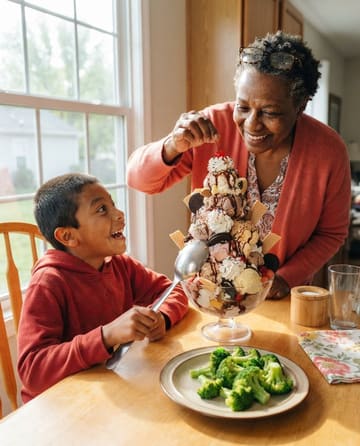
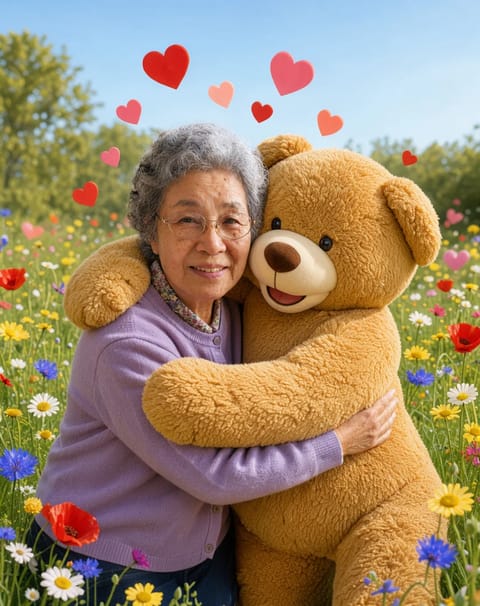
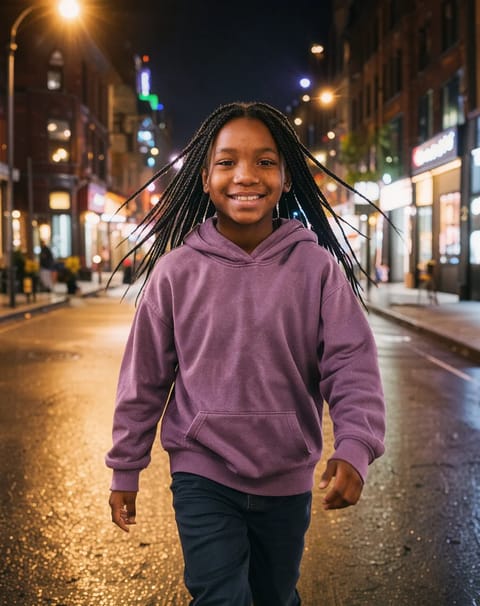
Why Thursday, of all days?
No one ever signed a paper choosing Thursday. It was a habit. In colonial New England, Sunday belonged to church, so days set aside for giving thanks went on weekdays, and Thursday was already the day many towns gathered for a weekly midweek sermon, known as the lecture. A thanksgiving on Thursday fit the week people already had.
When Congress asked George Washington for a national day of thanks, he proclaimed Thursday, November 26, 1789. Governors and later presidents kept choosing Thursdays, and by the Civil War nobody had to ask which day. The only question left was which week.
The four-day weekend was nobody's plan. It's a happy side effect of a Puritan calendar.
Lincoln, Sarah Josepha Hale and the last Thursday of November
Before 1863, each state set its own Thanksgiving, on its own date, if it held one at all. Sarah Josepha Hale, a magazine editor, spent years writing to presidents and governors asking for one national day. On September 28, 1863, she wrote to Abraham Lincoln. Five days later, on October 3, he proclaimed the last Thursday of November a day of thanksgiving.
That Thursday was November 26, 1863. Presidents kept issuing a proclamation every year after that, and nearly always picked the last Thursday of November. It was tradition, not law, which left room for the fight that came next.
The year FDR moved Thanksgiving, and 16 states said no
In 1939, November had five Thursdays, so the last one fell on November 30. Franklin Roosevelt worried that a short Christmas shopping season would slow the economic recovery, so he moved Thanksgiving a week earlier, to November 23. Critics called it Franksgiving. According to the National Archives, 32 states went along and 16 kept the last Thursday, so for two years the country had two Thanksgivings archives.gov/legislative/features/thanksgiving.
Congress settled it. On October 6, 1941, the House voted to make the last Thursday of November the legal holiday. The Senate changed that to the fourth Thursday, which only matters in years with five Thursdays, and Roosevelt signed it on December 26, 1941. It has been the fourth Thursday ever since, so Thanksgiving always lands between November 22 and November 28.
| Year | Thanksgiving | Why it matters |
|---|---|---|
| 1789 | Thursday, November 26 | Washington's first national day of thanks |
| 1863 | Thursday, November 26 | Lincoln's last Thursday of November |
| 1939 | Thursday, November 23 | FDR moves it a week early; 16 states refuse |
| 1941 | Law signed December 26 | Congress fixes it on the fourth Thursday |
| 2026 | Thursday, November 26 | This year |
| 2027 | Thursday, November 25 | Next year |
| 2028 | Thursday, November 23 | Five Thursdays again: the old rule would have said November 30 |
Why do we eat turkey on Thanksgiving?
Only two accounts of the 1621 Plymouth harvest feast survive, and neither is a menu. Edward Winslow wrote that the governor "sent four men on fowling," and that the Wampanoag leader Massasoit came with some ninety men, who "went out and killed five deer" for a celebration that lasted three days. William Bradford, describing that fall, wrote that "besides waterfowl there was great store of wild turkeys, of which they took many, besides venison" pilgrimhall.org/thanksgiving-national-day-of-mourning/the-first-thanksgiving.
So the first feast certainly had deer and wild birds, and turkey may well have been among them, next to ducks and geese. Nobody wrote down pumpkin pie, potatoes or cranberry sauce.
Turkey won the table later, for practical reasons. It's a native bird, big enough to feed a whole family, and unlike a hen or a cow it wasn't needed alive for eggs or milk. Then Sarah Josepha Hale, the same editor who wrote to Lincoln, gave a whole chapter of her 1827 novel Northwood to a New England Thanksgiving dinner, with the roast turkey at the head of the table. When Thanksgiving went national, the turkey went with it.
The turkey pardon: what's true and what's legend
Every November a president spares a turkey on camera. The tradition is real; most of its origin stories are not, as NPR laid out npr.org/2018/11/19/669235324/the-presidential-turkey-pardons-weird-roots-go-back-to-the-iran-contra-scandal.
| The story | What the record says |
|---|---|
| Lincoln's son Tad saved a turkey | A reporter's account says Tad pleaded for a bird meant for a holiday dinner in the 1860s. It's often told and hard to confirm. |
| Truman pardoned the first turkey in 1947 | No. The National Turkey Federation gave Truman a turkey in 1947, and his presidential library has found no record of a pardon. Those birds were dinner. |
| Kennedy spared one in 1963 | True. Looking at a bird with a sign that read "Good eating, Mr. President," he said, "We'll just let this one grow." |
| Reagan said pardon first | True, in 1987, as a joke. Reporters were asking about pardons in the Iran-Contra affair; the turkey, Charlie, was already headed to a petting zoo. |
| George H. W. Bush made it official | True. In 1989 he said the bird had been "granted a presidential pardon as of right now," and every president since has held the ceremony. |
How we made the Thanksgiving cards
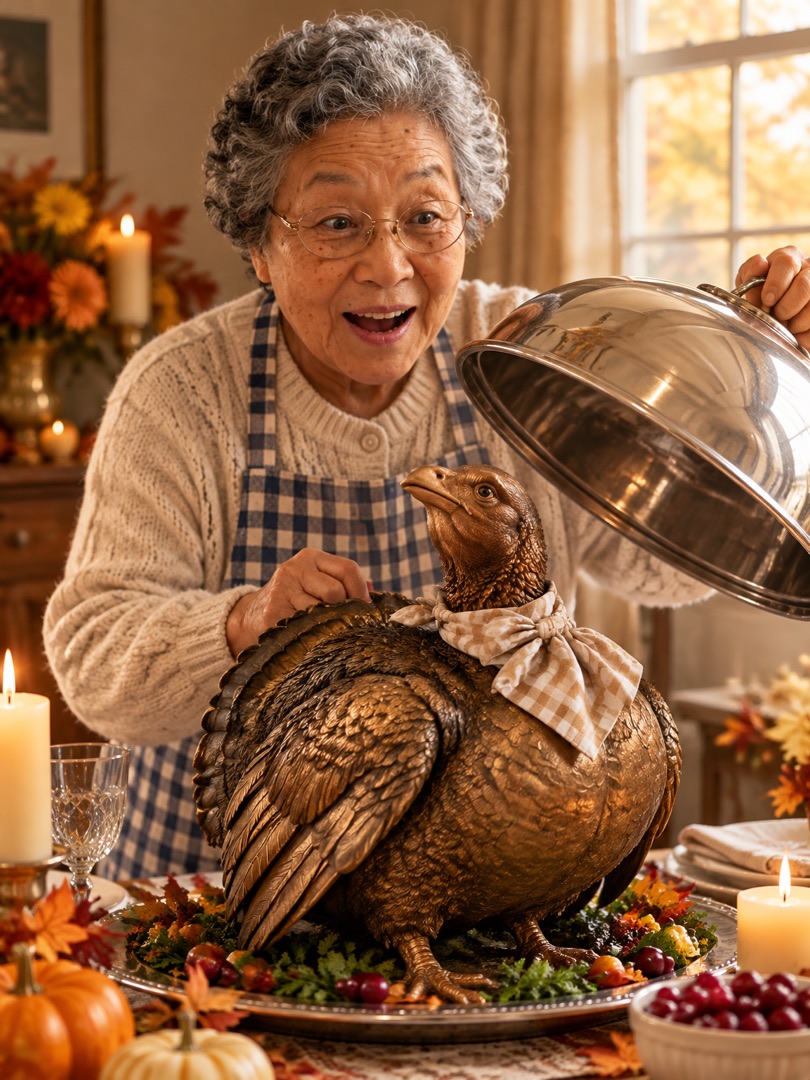
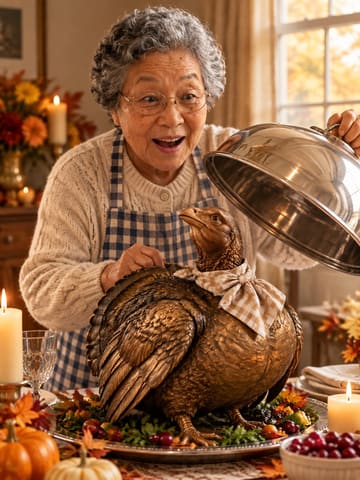
Our first Thanksgiving card is built on one beat: you lift the lid, and dinner is still alive. The person in your photo stands at the head of a set table in a sweater and a checked apron, lifting a silver dome. Under it, a live bronze turkey with a napkin tied around its neck looks back, completely calm. In the video it picks up a dinner roll in its beak, hops off the platter and struts away down the table between the candles. They watch it go, put the lid back on the empty platter and give the camera a long look.
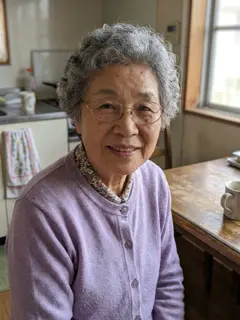
It came with rules. The turkey is alive and fine in every frame: no knife, no carving, nothing cooked with a face. No Pilgrim or Native costumes, on this card or any Thanksgiving card. The test cook was Mei, 76, who doesn't exist and has never roasted anything. Bronze is a real turkey breed; ours took the word a little literally and came out with the shine of a trophy.
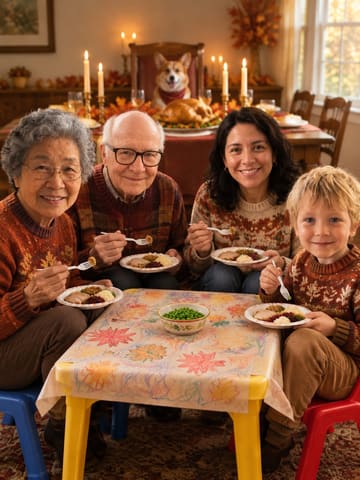
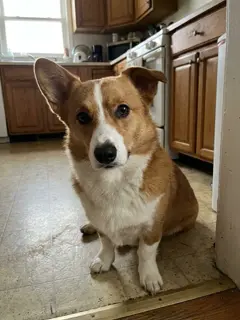
The second card is the kids' table. Up to five photos, one per person, and everyone squeezes around a tiny plastic table on child-size chairs with their knees near their chins, while the family dog sits at the head of the grown-ups' table with a napkin around its neck. If the last photo is your dog, it gets the big chair; without one, a corgi fills in. In the video the dog calmly lifts the turkey leg off the platter and starts chewing; one by one the family turns around, and the dog keeps chewing. The rule here: the joke is the chairs and the dog, never who ate how much.
Both were tried many times on our made-up test family, 12 people, a corgi and a cat, and graded on whether everyone still looks like themselves and whether it's funny. Your message goes on the card under the picture, and it arrives as a link that opens on any phone, which helps if you remember on Thanksgiving morning. For the message, there are 80 lines in our Thanksgiving wishes; the cards are on funny Thanksgiving cards, and for the host who did all the cooking, thank-you messages.
How it works
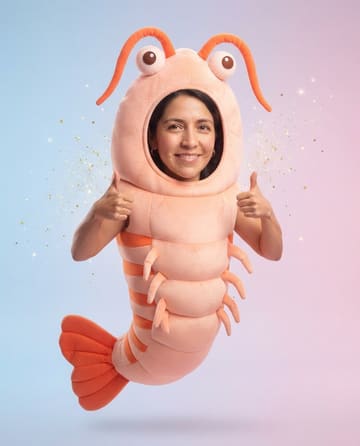
- Pick a cardPilots, mermaids, rock stars, one very surprised cake. Every one shows a real example first.
- Add their photosOne clear face each, up to 5 people. A selfie is fine. No sign-up.
- Preview it, then payOne picture of them in the card in about 10 seconds. Like it? Apple Pay or Google Pay, and four pictures arrive about 20 seconds later, the video in about 90.
Has there ever been a Thanksgiving not on a Thursday?
Not since it became a yearly national holiday in 1863: every one has been on a Thursday. The 1939 fight was about which Thursday, never which day.
Which US president refused to celebrate Thanksgiving?
Thomas Jefferson. He declined to proclaim a national day of thanksgiving, writing in 1808 that the Constitution kept the president from "intermeddling with religious institutions" and that the matter belonged to the states.
What was on the first Thanksgiving menu?
The only foods written down are five deer brought by the Wampanoag and wild fowl, which may have included turkey. Corn was the colony's main crop that year, so it was likely there in some form. No pie, no potatoes, no cranberry sauce.
What is the real story behind Thanksgiving?
The 1621 Plymouth feast was a three-day harvest celebration shared by about 50 English colonists and about 90 Wampanoag men. The colonists didn't call it a thanksgiving; that name came much later. Since 1970, many Native people have marked the day as a National Day of Mourning.
By HiWith (Winding AI, Inc.) · support@winding.ai · Updated