The birthday paradox, explained
The birthday paradox: in a group of just 23 people, there's a 50.7% chance that at least two share a birthday. With 50 people it's 97%, and with 75 it's 99.97%.

Who’s in it?

Pay, and it’s ready in about 20 seconds
Four pictures to pick from, no watermark, a link that opens on any phone. We email it to you too.
Sent. Its link opens this card.
Put 23 people in a room and the chance that at least two of them share a birthday is 50.7%, a little better than a coin flip. At 50 people it's 97%. It's called the birthday paradox because the gut answer is something like 183, half of 365, and the gut is way off.
Below: why it works, a table we checked in Python, the twist that makes it feel wrong, what it means for an office birthday calendar, and our own birthday problem: test pictures that kept giving coworkers the same face.
Cards made from your photos
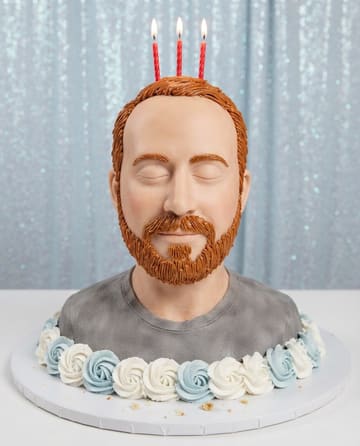

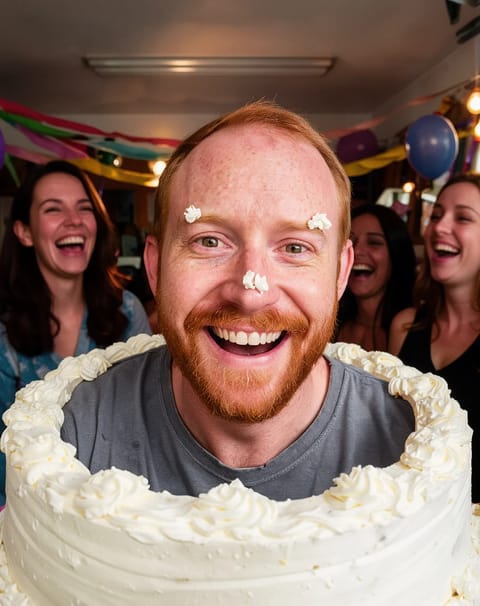



Why do 23 people give better-than-even odds?
Because you're not comparing everyone to one birthday. You're comparing everyone to everyone. Twenty-three people make 253 different pairs, and every pair gets its own 1-in-365 shot at a match.
The easy way to do the math is backwards: work out the chance that nobody matches. The first person can have any birthday. The second has to miss one date, so 364/365. The third has to miss two, 363/365, and so on down to 343/365 for the 23rd.
Multiply those 22 fractions and you get 49.3%. So the chance of at least one shared birthday is 50.7%.
As a formula, the chance of a match among n people is 1 minus (365 × 364 × … × (365 − n + 1)) ÷ 365 to the power of n. It assumes 365 equally likely birthdays and no twins. Australia's Office of the Chief Scientist walks through the same sums using an office of 23 employees (chiefscientist.gov.au/2011/05/the-birthday-problem).
How many people for a 50% chance? The table
We checked every row in Python by multiplying out the fractions, no shortcuts. Ignoring February 29, it takes 366 people to make a shared birthday certain, but you're past 99% at 57.
Real birthdays aren't evenly spread: September is crowded and Christmas is quiet. Run the same math on US birth data from 1994 to 2014 and 23 people come out at 50.8%. Lumpy birthdays make a match slightly more likely, not less, and the most common birthdays are why.
| People in the room | Chance two share a birthday |
|---|---|
| 5 | 2.7% |
| 10 | 11.7% |
| 15 | 25.3% |
| 20 | 41.1% |
| 23 | 50.7% |
| 30 | 70.6% |
| 40 | 89.1% |
| 50 | 97.0% |
| 57 | 99.0% |
| 70 | 99.9% |
| 75 | 99.97% |
| 100 | 99.99997% |
| 366 | 100% |
Why does the birthday paradox feel so wrong?
Because when you hear "someone shares a birthday," you think of your own. That's a much harder question. In a room of 23, the chance that someone shares yours is about 6%. To get a coin flip on your own birthday, you need 253 other people.
Here's a tidy coincidence: 253 is also the number of pairs in a room of 23. Same number, two different questions, both landing right around 50%.
The trick scales in odd directions. With 88 people there's an even chance that three share a birthday, and with only 14 it's a coin flip that two have birthdays on the same day or one day apart, per the same Chief Scientist page. Mathematicians have been passing the puzzle around since at least the 1930s; the first version in print is usually traced to Richard von Mises in 1939.
What it means for the office birthday calendar
If your team has 23 people, it's a coin flip that two of them share a birthday. At 41 people it's 90%. At 57 it's 99%, so in most mid-sized offices somebody is going to have to share a cake.
There are two ways to handle it. One cake with both names, which is efficient and slightly sad. Or two of everything, which is correct. Either way each of them gets their own card: birthday wishes for a coworker has short lines for the card, and coworker birthday memes has the ones for the group chat.
Once the cake question is settled, there's the other office date everyone half remembers: the start date. For that one, there are work anniversary memes.
How we made the Office legend card
Office legend is the card for the coworker whose birthday it is (or one of them, see above). They're lifted up by cheering coworkers under a giant trophy, confetti over the desks, a sheet cake waiting. The first photo is the star; add a few coworkers' photos and they join the scene.
We tested the idea on Sofia, 30, from our made-up test family, by asking for a crowd-surf across a cubicle office with a slice of cake held high. Several takes skipped the crowd-surf and sat her on the cubicle wall instead, like she was waiting for a bus.
Others had the birthday problem in a different form: crowds where several coworkers shared one face. The graders mark that down. Pictures love twins, and twins break the birthday math too, since the 50.7% assumes nobody in the room is one.
One take even gave the shocked boss the face of a famous TV actor. Every card's picture instructions say no celebrities, and that take is why we're glad they do.



How it works
- Pick a cardPilots, mermaids, rock stars, one very surprised cake. Every one shows a real example first.
- Add their photosOne clear face each, up to 5 people. A selfie is fine. No sign-up.
- Preview it, then payOne picture of them in the card in about 10 seconds. Like it? Apple Pay or Google Pay, and four pictures arrive about 20 seconds later, the video in about 90.
How many people in a room to share a birthday 100%?
366 if you ignore February 29, because with 365 possible birthdays the 366th person has to repeat one. Count leap day and it's 367. You're past 99% long before that, at 57.
Is it someone's birthday every day of the year?
Only in big groups. On average you need about 2,365 people before every one of the 365 days has a birthday on it. A 100-person office goes about 278 days a year with no birthday at all.
How many couples share a birthday?
About 1 in 365, if birthdays are random, or roughly 0.27% of couples. Any two people have the same odds, married or not.
By HiWith (Winding AI, Inc.) · support@winding.ai · Updated