Who wrote Happy Birthday to You?
Sisters Mildred and Patty Hill of Louisville, Kentucky wrote the tune in 1893 as "Good Morning to All." Nobody has proven who wrote the birthday words, and the song has been in the US public domain since 2016.
Who’s in it?
Pay, and it’s ready in about 20 seconds
Four pictures to pick from, no watermark, a link that opens on any phone. We email it to you too.
Sent. Its link opens this card.
Two sisters from Louisville, Kentucky wrote the tune. Mildred Hill composed it with help from her younger sister Patty, a kindergarten teacher, and Patty wrote the words. Only the words were "Good morning to you," printed in an 1893 songbook for kindergartens. The birthday lyrics turned up later, credited to no one.
Then came a copyright claim, decades of licensing fees, a lawsuit by filmmakers, and a judge who wrote one of the best lines in American legal history. Here's the whole story, plus why the birthday videos we make for cards have party noise and no singing at all.
Cards made from your photos


Who really wrote Happy Birthday?
The melody came first. Mildred, the older sister, composed it with Patty's help some time before 1893, and Patty wrote a greeting for little kids to sing at the start of the school day. In 1893 the sisters signed the song over to a publisher, Clayton F. Summy, who printed it in a book called Song Stories for the Kindergarten. The words went like this:
- Good morning to you
- Good morning to you
- Good morning, dear children
- Good morning to all
When did Good Morning to All become Happy Birthday?
The birthday words are murkier. A 1901 teachers' journal describes a birthday child standing in the middle of a circle, wearing a flower or a badge, while the class sings "Happy birthday to you." The full lyrics first appeared in print in a 1911 book, The Elementary Worker and His Work, with no author named.
Patty said in a 1934 deposition that she wrote the birthday words around the same time as the morning ones. Maybe she did. The federal judge who sorted through the record in 2015 called the origins of the lyrics "less clear," and nobody has settled it since. Here's how a classroom greeting became the song every cake gets:
| Year | What happened |
|---|---|
| 1893 | Song Stories for the Kindergarten prints Good Morning to All |
| 1901 | A teachers' journal mentions kids singing Happy birthday to you |
| 1911 | The full birthday lyrics appear in print, credited to nobody |
| 1933 | The song is sung in the Broadway revue As Thousands Cheer |
| 1934 | Jessica Hill, a third sister, sues the show's producers over the melody |
| 1935 | The Summy company registers a copyright for Happy Birthday to You |
| 1949 | The copyright on Good Morning to All, melody included, runs out |
| 1988 | Warner/Chappell buys the company holding the claim, for a reported $25 million |
| 2013 | Filmmakers and a musician sue to have the copyright declared invalid |
| 2015 | A federal judge rules the publisher never owned the lyrics |
| 2016 | A $14 million settlement, and the song enters the public domain |
Is Happy Birthday copyrighted?
No. In the US, Happy Birthday has been in the public domain since 2016, so anyone can sing it, record it or put it in a movie without asking or paying. In the European Union, the sisters' rights ran out on January 1, 2017, 70 years after Patty died.
It took a lawsuit. For decades the publisher, Warner/Chappell, charged films, shows and ads to use the song, reportedly about $2 million a year. Its claim rested on a 1935 registration by the Summy company.
In September 2015, Chief Judge George H. King of the federal court in Los Angeles read the paper trail and found that the sisters had given Summy the melody and some piano arrangements, and never the lyrics.
His order has the best sentence in the whole case: "Obviously, pianos do not sing." Rights to a piano arrangement aren't rights to words, and since Summy never got the lyrics, neither did anyone who bought Summy later. You can read all 43 pages: eff.org/files/2015/09/23/282431790-hbd-summary-judgment-order.pdf
In June 2016 the judge approved a settlement. Warner/Chappell agreed to pay back $14 million in licensing fees, and the song went into the public domain for good (cbsnews.com/news/happy-birthday-song-officially-recognized-in-public-domain).
Why do we sing Happy Birthday?
Because kindergarten teachers did. That 1901 scene, a child with a flower in the middle of a circle while everyone sings, is every office break room today minus the flower. From classrooms the song spread to church songbooks in the 1920s, then into movies in the early 1930s, and once it was on screen and on Broadway it was everywhere.
It's also short, it has a blank for a name, and it's easy right up to the third line, where the tune jumps a full octave on "birth." That's the moment the room splits into three keys. In an office of 23 people it's better than even odds that two share a birthday (the birthday paradox), so some days you get to attempt it twice.
It has even been played on Mars. In August 2013, for its first year on the planet, NASA's Curiosity rover played the tune to itself by vibrating one of its science instruments at different pitches. No lyrics, no singing, no candles. We relate.
How we made the Rock star card (where nobody sings)
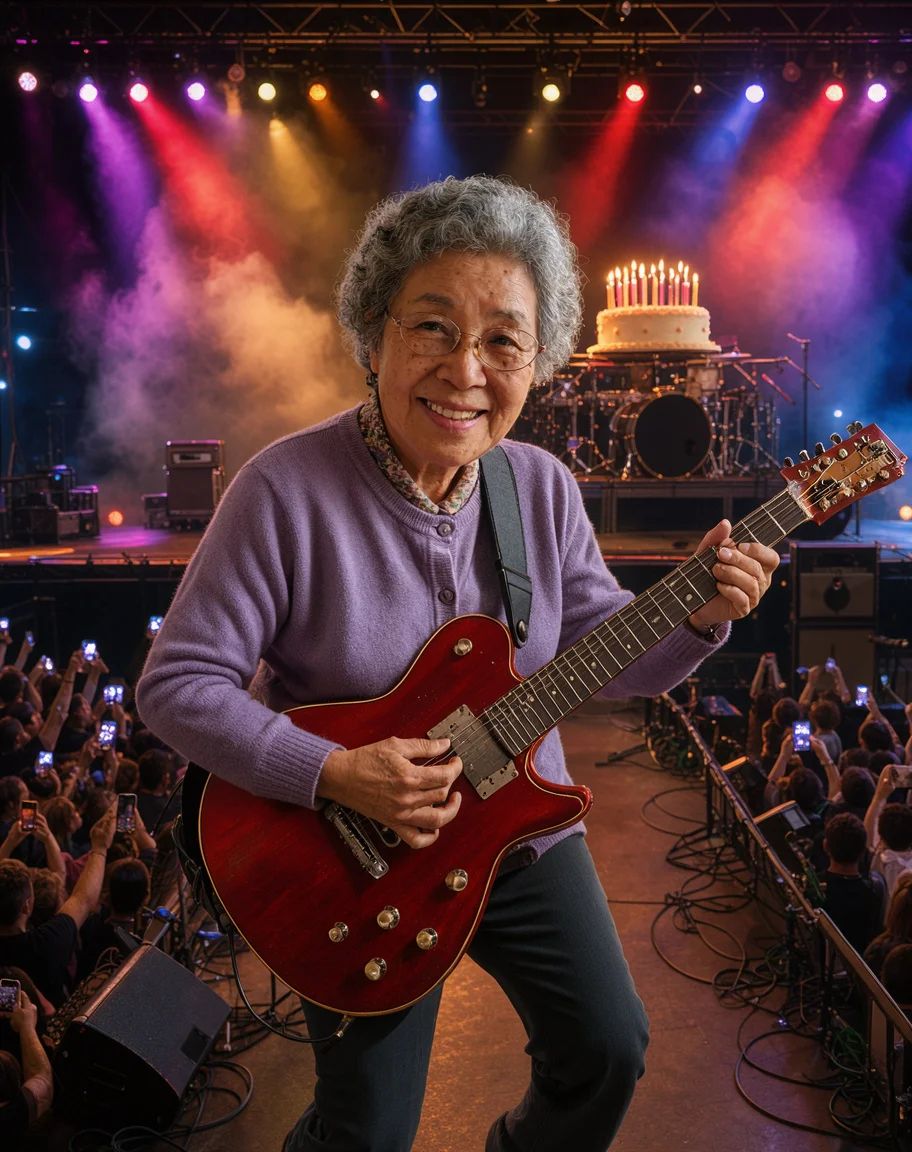
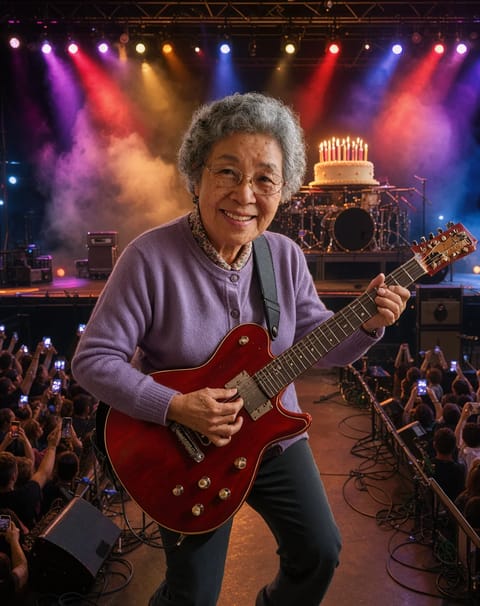
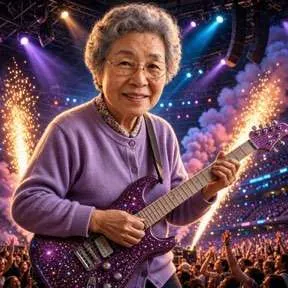
Our cards star the people in your photos, and the Rock star card puts the birthday person on a huge stage: smoke, colored lights, a crowd holding up phone lights and a giant birthday cake on the drum riser. The video adds a big guitar strum, sweeping lights and confetti cannons.
What it doesn't add is singing. Card videos get one sound rule: party sound effects only, nobody speaks or sings.
The rule has teeth. If a clip comes back with three or more real words in it, it's thrown out and made again. "Woo" and "yay" don't count as words. "Happy birthday to" does.
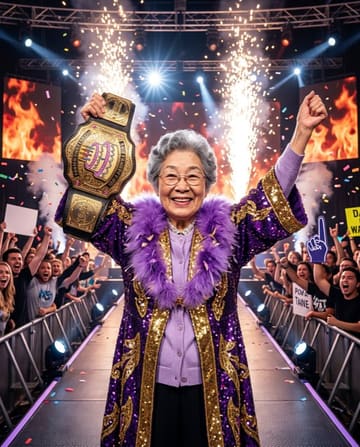
The card was tested the way all of ours are, on a test family of 12 made-up people, a corgi and a cat, none of whom exist. Mei, our 76-year-old test grandma, has played her own 80th birthday show more than 60 times. Each take is graded on whether she still looks like Mei, whether it's funny, whether it fits the card and whether it's well made.
One version of our instructions asked every take for one funny detail in the background. Mei got a chicken on a stick in one take and a puppy in a bandana in another. That line didn't survive the next version.
So the singing is yours. The song is public domain, after all. Send the funny birthday card, put your message under the picture, then call and do the octave jump yourself. If it's for her, the birthday wishes for Grandma page has lines for the card if you'd rather write than sing.


How it works
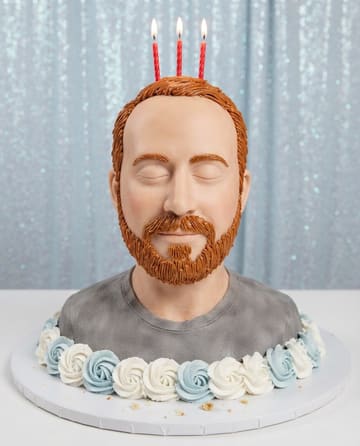
- Pick a cardPilots, mermaids, rock stars, one very surprised cake. Every one shows a real example first.
- Add their photosOne clear face each, up to 5 people. A selfie is fine. No sign-up.
- Preview it, then payOne picture of them in the card in about 10 seconds. Like it? Apple Pay or Google Pay, and four pictures arrive about 20 seconds later, the video in about 90.
Is it legal to sing Happy Birthday in public?
Yes. The song has been in the public domain in the US since 2016, so you can sing it in a restaurant, record it or put it in a video without a license. In the European Union, the rights ran out at the start of 2017.
Does anyone get royalties from the Happy Birthday song?
Not anymore. After the 2015 ruling, Warner/Chappell agreed to pay back $14 million to people who had paid to use the song, and nobody collects on it now.
Is Happy Birthday the most sung song?
Nobody can count every kitchen, but the 1998 Guinness World Records book called it the most recognized song in the English language, ahead of For He's a Jolly Good Fellow.
What famous song has no copyright?
Happy Birthday, since 2016. So does every song published in the US in 1930 or earlier: as of January 1, 2026, their music and words are all in the public domain.
By HiWith (Winding AI, Inc.) · support@winding.ai · Updated