What does Auld Lang Syne mean? (Every line, translated)
Auld lang syne is Scots for "old long since," meaning long ago or the old days. "For auld lang syne" means "for old times' sake." The song, written down by Robert Burns in 1788, asks whether old friends should be forgotten and answers by raising a drink to them.
Who’s in it?
Pay, and it’s ready in about 20 seconds
Four pictures to pick from, no watermark, a link that opens on any phone. We email it to you too.
Sent. Its link opens this card.
Your first 2 cards are free 🎁
Where should we send it? Four pictures, no watermark, and the video, with a link to open it.
Auld lang syne is Scots for "old long since": long ago, the old days. So "for auld lang syne" means "for old times' sake." The whole song asks one question, should old friends be forgotten, and answers it by buying a round. Robert Burns sent it to a friend in 1788, calling it an old song he'd heard, and singing it at midnight started in Scotland and traveled with everyone who left.
Below: what each word means, all five verses in Burns's Scots with a plain-English line beside each one, how to say syne (not the way most of us sing it), why it's the midnight song, when to cross your arms, and some New Year card lines borrowed from it.
What does Auld Lang Syne mean, word by word?
Auld means old, lang means long, and syne means since, as in "long since" or "ago." Put together, auld lang syne is the old days, times long past. The song uses it two ways: "and auld lang syne" (should the old days be forgotten too?) and "for auld lang syne" (for the sake of the old days).
The rest of the chorus is just as plain once you know a few words. Here's the title and chorus, one word at a time.
| Scots | Plain English |
|---|---|
| auld | old |
| lang | long |
| syne | since, ago (it rhymes with sign) |
| auld lang syne | the old days; long ago |
| for auld lang syne | for old times' sake |
| auld acquaintance | old friends, people you've known a long time |
| my jo | my dear (most crowds sing "my dear") |
| a cup o' kindness | a drink of goodwill: a toast |
| yet | still, even now |
Cards made from your photos


Auld Lang Syne lyrics: the verse everyone sings
At midnight, most people sing the first verse and the chorus, then hum while looking at someone else's mouth. Here it is in Burns's words with a plain-English line next to each. Burns died in 1796, so the words are long out of copyright and everyone's to sing.
Crowds change it a little. "My jo" usually becomes "my dear," and plenty of people sing "and days of auld lang syne" in the fourth line. Both are fine. Nobody at a party has ever checked.
| Burns's Scots | In plain English |
|---|---|
| Should auld acquaintance be forgot, / and never brought to mind? | Should old friends be forgotten and never thought of again? |
| Should auld acquaintance be forgot, / and auld lang syne? | Should old friends be forgotten, and the old days too? |
| Chorus: For auld lang syne, my jo, / for auld lang syne, | For old times' sake, my dear, for old times' sake, |
| we'll tak' a cup o' kindness yet, / for auld lang syne. | we'll still raise a toast to each other, for old times' sake. |
All five verses of Auld Lang Syne, as Burns wrote them
The full song has five verses, with the chorus after each one. Verses two to five are where the story is: two old friends who grew up together, drifted apart, and meet again for a drink. Here they are in Scots, as most editions print Burns's text, with plain English beside each pair of lines.
Verse two is our favorite. "Surely ye'll be your pint-stoup" means "surely you'll pay for your pint," with "be" in the old sense of standing the cost. Burns's idea of a moving reunion: you buy yours, I'll buy mine.
| Burns's Scots | In plain English |
|---|---|
| 1. Should auld acquaintance be forgot, / and never brought to mind? | Should old friends be forgotten and never thought of again? |
| Should auld acquaintance be forgot, / and auld lang syne? | Should old friends be forgotten, and the old days too? |
| Chorus: For auld lang syne, my jo, / for auld lang syne, | For old times' sake, my dear, for old times' sake, |
| we'll tak' a cup o' kindness yet, / for auld lang syne. | we'll still raise a toast to each other, for old times' sake. |
| 2. And surely ye'll be your pint-stoup! / and surely I'll be mine! | And surely you'll buy your pint, and I'll buy mine! |
| And we'll tak' a cup o' kindness yet, / for auld lang syne. | And we'll still raise a toast, for old times' sake. |
| 3. We twa hae run about the braes, / and pou'd the gowans fine; | The two of us ran around the hillsides and picked the pretty daisies, |
| But we've wander'd mony a weary fit, / sin' auld lang syne. | but we've walked many a tired mile since the old days. |
| 4. We twa hae paidl'd in the burn, / frae morning sun till dine; | The two of us paddled in the stream from morning until dinnertime, |
| But seas between us braid hae roar'd / sin' auld lang syne. | but wide seas have roared between us since the old days. |
| 5. And there's a hand, my trusty fiere! / and gie's a hand o' thine! | So here's my hand, my trusty friend, and give me yours! |
| And we'll tak' a right gude-willie waught, / for auld lang syne. | And we'll take a long, friendly drink, for old times' sake. |
Who wrote Auld Lang Syne?
Robert Burns, mostly, and by his own account not entirely. He sent the song to his friend Frances Dunlop in a 1788 letter, introducing it as "an old song and tune which has often thrilled thro' my soul," and he later told the publisher George Thomson he'd taken it down from an old man's singing. The musicologist Morag Grant, who wrote a whole book on the song, lays out the three camps: some take Burns at his word, some think the words are almost all his, and most land in between: doi.org/10.11647/OBP.0231
There really was an older song. A ballad called "Old Long Syne" was printed in James Watson's Choice Collection in 1711 and shares the opening question, "Should auld acquaintance be forgot." The Library of Congress notes that Burns wrote out six manuscripts of his version, no two exactly alike, and that most scholars credit him with at least two verses. In the Dunlop letter he praised the unknown author: "Light be the turf on the breast of the heaven-inspired Poet who composed this glorious Fragment!" blogs.loc.gov/folklife/2013/12/auld-acquaintance-for-the-new-year-burnss-auld-lang-syne
It first appeared in print in 1796, the year Burns died, in the fifth volume of James Johnson's Scots Musical Museum, set to a different tune. The melody everyone sings now came with Thomson's edition in 1799. Burns called the earlier air "mediocre," which may be the most useful review he ever wrote.
How do you pronounce Auld Lang Syne?
Say it "awld lang sign." Syne starts with an s and rhymes with sign, line and mine, which is why, in Burns's Scots, it rhymes with "mind" and "mine." In Scots the d in auld is light, almost "awl."
Most of the English-speaking world sings "zyne," with a z. That's the one detail Scots will notice, and The New European notes it's often mispronounced that way south of the border: theneweuropean.co.uk/for-old-times-past-my-dear Sing it with an s this year and you'll be correct, and a little louder than everyone else.
Why do we sing Auld Lang Syne on New Year's Eve?
Because the Scots did it first. Singing it at midnight on Hogmanay, the Scottish New Year's Eve, became a custom in Scotland, spread across Britain, and traveled with Scottish, English, Irish and Welsh emigrants around the world. A song about not forgetting old friends turns out to be exactly what people want at the one moment the year changes.
In the US, one bandleader made it the midnight song. Guy Lombardo and His Royal Canadians played New York's Roosevelt Hotel on December 31, 1929, in what was billed as the first nationwide New Year's Eve radio broadcast, and "Auld Lang Syne" became the band's sign-off for nearly 50 years of New Year's shows: canadianstampnews.com/otd-guy-lombardo-new-years-eve-party-premieres-new-york The opening of his 1947 recording still plays in Times Square right after the ball drops.
It does other endings, too: funerals, graduations, the last night of a camp. In Japan the tune carries different words as "Hotaru no Hikari," a graduation song, and a gentle version of it tells shoppers a department store is about to close. Same message everywhere: something's ending, and we were glad of each other. For the words you send instead of sing, see Happy New Year or Happy New Years, or how to say it in other languages.
When do you cross arms for Auld Lang Syne?
On the last verse, not the first. The Scottish way: everyone stands in a circle holding hands with the people beside them. When the verse that starts "And there's a hand, my trusty fiere" begins, everyone crosses their arms over their chest, so your right hand holds your left-hand neighbor's and the other way around. At the end, the circle rushes into the middle, then everyone turns under their arms to face out.
Outside Scotland, people often cross arms from the very first line. When Queen Elizabeth II held hands uncrossed at the Millennium Dome on New Year's Eve 1999 and crossed them only for the last verse, some papers said she'd done it wrong. She was following the Scottish custom. The crossed hands themselves are newer than the song; Grant traces singing it with linked, crossed hands to Freemasons and other clubs in the mid-1800s: en.wikipedia.org/wiki/Auld_Lang_Syne
So at midnight: hold hands, sing the first verse and chorus, cross arms when the hand verse comes. If your crowd only knows one verse, cross on the last chorus and nobody will know the difference.
New Year card lines borrowed from Auld Lang Syne
The song is a New Year card already: an old friend, a hand held out, a drink to the years you've had. These lines borrow its pieces and fit under a picture. For more, we keep Happy New Year wishes sorted by who's getting them, and New Year memes for the friend who'd rather laugh.
- For an old friend: Should auld acquaintance be forgot? Not this one. Happy New Year.
- For an old friend: Here's my hand, my trusty friend. Same as always. Happy New Year.
- For an old friend: Twenty years of auld lang syne, and you still pick up on the first ring.
- For someone far away: Seas between us, a toast across them. Happy New Year.
- For someone far away: Different cities, same old friend. Raising a cup of kindness at your midnight too.
- For someone far away: We've wandered a long way since the old days. Still glad it was with you.
- For family: To the old times, and to the ones we haven't had yet.
- For family: Same people, brand-new year. Still the best deal going.
- For a partner: My favorite auld acquaintance. Happy New Year.
- Funny: You'll buy your round and I'll buy mine. That's friendship, according to Robert Burns.
- Funny: We've wandered many a weary mile this year. Mostly to the fridge.
- Funny: Should auld acquaintance be forgot? I forgot your birthday, so let's call it even.
How we made New Year cards for old friends
Auld Lang Syne is a song about one specific person: the friend you ran around the hills with, who you now see once a year. That's who our New Year cards are for. You add one clear photo of each person, and they star in the scene. Every idea gets tried many times on our test family, made-up people who don't exist, and graded on whether they still look like themselves, whether it's funny and whether it's well made.
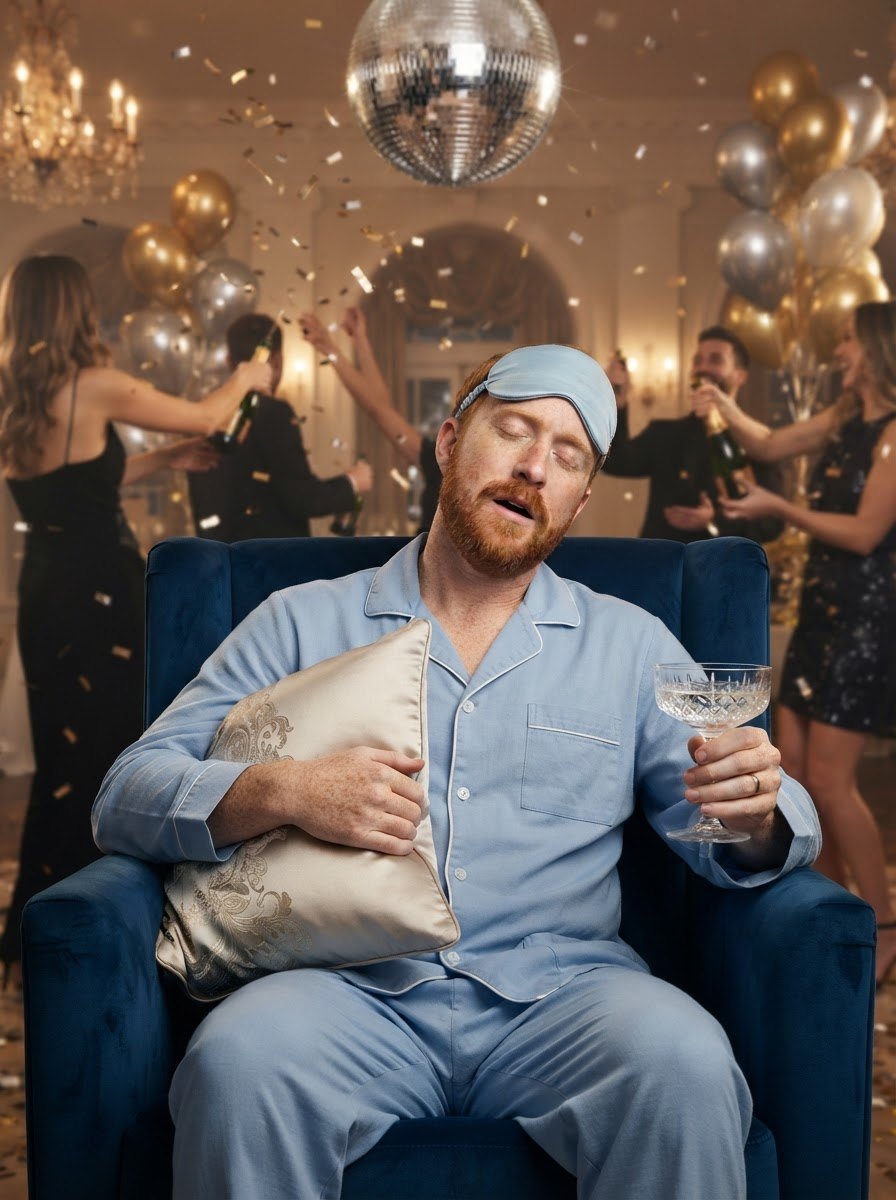
Slept Through It is the card for the friend who never hears the song. Dave, 38, is out cold in a velvet armchair in his pajamas, sleep mask pushed up, glass held perfectly level while the party goes on around him: a cup of kindness, untouched. An earlier version had him wide awake and toasting the camera, which missed the whole joke, so now he sleeps, a confetti cannon goes off beside him in the video, one eye opens, and he's gone again.
Riding the Ball Drop puts Mei, 76, on a glittering countdown ball, waving a cowboy hat over a cheering crowd: the moment just before the song starts. The square is made up on purpose, glass towers and plain windows, because early takes kept drawing a real one, billboards included.
Our videos have sound effects only, so nobody on a HiWith card sings Auld Lang Syne. Judging by most parties at 12:01, that's also true of everyone after the first verse.

Sources
We read each of these on November 18, 2026. If one changes, or a Scot catches us out, write to support@winding.ai and we'll fix it.
- Library of Congress, Folklife Today, on Burns's manuscripts, the 1788 Dunlop letter, Aytoun and Watson's 1711 collection, Johnson (1796) and Thomson (1799): blogs.loc.gov/folklife/2013/12/auld-acquaintance-for-the-new-year-burnss-auld-lang-syne
- Morag J. Grant, Auld Lang Syne: A Song and Its Culture (Open Book Publishers, 2021), chapter 2 on the song's origins and the "old man's singing" letter: books.openbookpublishers.com/10.11647/obp.0231/ch2.xhtml
- Wikipedia, Auld Lang Syne: Burns's text, the Scots pronunciation with s, the crossed-arms custom at Hogmanay and Japan's "Hotaru no Hikari": en.wikipedia.org/wiki/Auld_Lang_Syne
- The New European on saying syne like sign, not zyne: theneweuropean.co.uk/for-old-times-past-my-dear
- Canadian Stamp News on Guy Lombardo's first New Year's Eve broadcast, December 31, 1929, at the Roosevelt Hotel: canadianstampnews.com/otd-guy-lombardo-new-years-eve-party-premieres-new-york
- Peoria Journal Star via Yahoo on the real story behind "Same Old Lang Syne": yahoo.com/news/dan-fogelbergs-old-lover-recalls-113555155.html
How it works
- Pick a cardPilots, mermaids, rock stars, one very surprised cake. Every one shows a real example first.
- Add their photosOne clear face each, up to 5 people. A selfie is fine. No sign-up.
- Preview it, then payOne picture of them in the card in about 20 seconds. Like it? Apple Pay or Google Pay, and four pictures arrive about 20 seconds later, the video in about 90.
What is the definition of lang syne?
Lang syne is Scots for "long since": long ago. Auld lang syne adds "old," so it means the old days, and "for auld lang syne" means for old times' sake.
What does "should auld acquaintance be forgot" mean?
"Should old friends be forgotten?" It's a question the song expects you to answer no. The rest of the verses are the reasons: the hills you ran around, the stream you paddled in, and a drink together now.
What does "a cup of kindness" mean in Auld Lang Syne?
A drink shared in friendship: a toast. "We'll take a cup of kindness yet" means we'll still raise a glass to each other, even after all these years.
Is Auld Lang Syne sung at funerals?
Yes, often, along with graduations, retirements and the last night of camp. It's a song about remembering people, so it fits any goodbye, not only the year's.
Is Auld Lang Syne a true story?
Burns's song is a poem about old friends, not one real meeting. You may be thinking of Dan Fogelberg's 1980 song "Same Old Lang Syne," which is true: it's about running into his high school girlfriend, Jill Anderson Greulich, at a Peoria, Illinois, convenience store on Christmas Eve 1975. She told the story after his death in 2007.
What song has the same melody as Auld Lang Syne?
In Japan, "Hotaru no Hikari" uses the tune with different words and is sung at graduations; stores play it at closing time. Many songbooks and scout groups also set their own farewell words to it.
Is Auld Lang Syne a Christmas song?
No, it's a New Year song. It's about the old year and old friends, which is why it plays at midnight on December 31, and why it fits a New Year card better than a Christmas one.
Why do Scots cross arms during Auld Lang Syne?
In the Scottish custom the circle holds hands uncrossed and everyone crosses their arms only at the last verse, "And there's a hand, my trusty fiere," which is about offering your hand. Crossing from the start is the more common habit outside Scotland.
By HiWith (Winding AI, Inc.) · support@winding.ai · Updated